
The Role of Stone Slingers in Erosion Control and Slope Stabilization
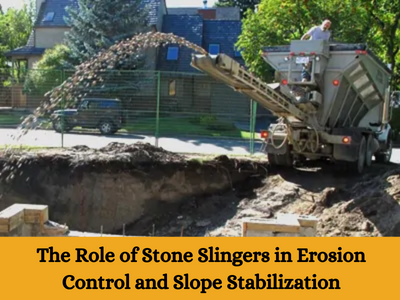
Stone slingers control erosion by placing crushed stone and aggregate precisely onto slopes and bare soil, forming an interlocking layer that resists water runoff. Their conveyor reach covers steep or hard to access ground evenly, without heavy machinery on the slope, which makes them faster and less disruptive than manual placement.
Erosion control and slope stabilization are critical parts of almost every construction and landscaping project, and in a region like Toronto the challenge is bigger than most. Our clay heavy soils, ravine lots, and hard freeze thaw winters put constant pressure on sloped ground, and a bare or poorly built slope can wash out after a single heavy storm. At We Deliver Gravel, we help homeowners and contractors across Toronto, Vaughan, and the GTA get slopes stabilized the right way, and this guide explains how a stone slinger solves that problem, which materials work best, and how to get the job done properly the first time.
What are erosion control and slope stabilization?
Erosion control is the practice of preventing soil loss caused by water and wind, which construction activity often makes worse. Slope stabilization is the work of holding a sloped surface in place so it does not slide, slump, or wash away. The two go together: a stable slope resists erosion, and good erosion control keeps a slope stable.
Which gravel is best for erosion control?
Choosing the right material matters as much as placing it well. Angular crushed stone is almost always the right family of material, because the sharp edges lock together and resist moving water. Here is how the common options compare:
| Material | Best Suited For | Key Benefit |
|---|---|---|
| Granular A / ¾ crushed limestone | Driveways and moderate slopes | Angular edges compact into a firm, load-bearing base |
| ¾ clear limestone (clear stone) | Drainage-heavy slopes and French drains | Open voids let water pass through without washing out |
| Large river rock / rip rap | Steep embankments and shorelines | Heavy stones resist displacement in fast-moving water |
| River rock | Gentle grades and decorative swales | Slows runoff while keeping a natural look |
Important: Avoid smooth pea gravel on any real slope. Its rounded stones do not interlock, so they slide and wash away in heavy rain, leaving the soil exposed. Save pea gravel for flat paths and decorative beds.
How deep should gravel be, and how is it installed?
Getting the depth and base right is what makes slope work last. A typical approach looks like this:
- Clear the area of loose debris and vegetation so you start on solid ground.
- Excavate roughly 4 to 6 inches, deeper for steeper slopes or heavier water flow.
- Lay geotextile fabric underneath to stop soil from migrating up into the stone.
- Place angular stone evenly, matching stone size to the slope. Steeper slopes need larger stone.
- For slopes steeper than about 30 degrees, combine stone with a retaining wall or a cellular stabilization grid.
Quick tip: The steeper the slope, the larger the stone. Fine material may look tidy, but on a steep grade it moves with the first big rain. Weight and angularity are what hold a slope together.
Why use a stone slinger for slope work?
A stone slinger is a specialized truck with a conveyor belt that throws material exactly where it is needed, often up to around 100 feet from the truck. That reach is a major advantage on slopes, where getting material into place is usually the hardest part. Here is what it delivers:
- Precision placement: material lands accurately on slopes and erosion prone spots, which cuts waste and gives even coverage.
- Less site disturbance: no heavy machinery has to drive onto the slope, so the ground stays intact and the approach stays eco friendly.
- Speed and lower labour cost: a slinger places in minutes what would take a crew hours of wheelbarrow and shovel work.
- Uniform coverage: even distribution means fewer weak points where erosion can start.
For tight or hard to reach properties, this is often the only practical way to get stone onto a slope at all.
Why slope stabilization matters in Toronto and the GTA
Local conditions make this work especially important here. Toronto and Vaughan sit on largely clay based soils that swell when wet and shift through repeated freeze thaw cycles, which loosens slopes and opens the door to washouts. Ravine lots and sloped backyards are common in areas like Scarborough, the Bridle Path, High Park, and across Vaughan neighbourhoods such as Woodbridge and Kleinburg. Matching the right aggregate to the slope, and placing it with proper drainage, is what keeps that ground stable season after season.
Get erosion control gravel delivered across Toronto and the GTA
For slope and drainage projects, homeowners and contractors most often reach for ¾ clear limestone, Granular A, and large river rock. Every slope is different, so browse our full range of gravel products to match the right stone to your terrain.
Whether you are stabilizing a ravine slope, armouring a shoreline, or fixing a washout in the backyard, We Deliver Gravel can get the right stone to your property and place it exactly where you need it. With our stone slinger service in Toronto, Vaughan, and across the GTA, we make delivery and precise placement simple. Call us at 647-868-2447 for pricing and advice, or get in touch to plan your erosion control project.
