
What is concrete sand? Uses, grades, and when to use it
If you have ever stood in front of a pile of sand and wondered whether it was the right kind for your job, you are not alone. Sand looks simple, but the wrong type can leave you with a patio that shifts, a driveway base that never sets, or a project that costs more to redo than it did to build. This guide is here to clear that up. At We Deliver Gravel, we handle gravel delivery in Toronto, Vaughan, and across the Greater Toronto Area every single day, so we know exactly what this material is, what it does, and when it belongs on your site. Here is everything you need to know before you order.
Concrete sand comes up on almost every project we deliver for, and it is easy to see why people get it mixed up with other types of sand. It has a specific texture, a specific job, and a few grades that suit different tasks, so choosing the right one makes a real difference to how your finished surface holds up. In the sections below, we walk through what it actually is, the main ways it gets used, how to pick the right grade, and how to work out how much you need before you place your order.
What is concrete sand, exactly?
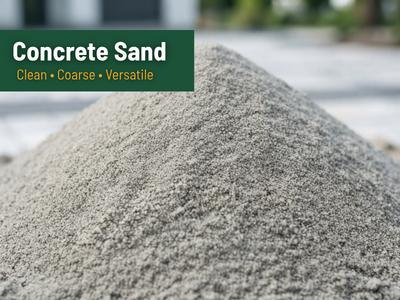
Concrete sand is a coarse, washed sand that is screened to remove very fine particles and debris. The grains are larger and more angular than the soft sand you might picture at a beach, and that texture is the whole point. Those sharp edges lock together under pressure, which gives you a firm, stable layer that holds its shape once it is compacted.
It is often called coarse sand or C33 sand, a reference to a common industry gradation standard. Because it is washed and screened, it carries very little silt or clay, so it mixes cleanly and drains freely instead of trapping water.
What is concrete sand used for?
This is a genuine workhorse material. Here are the jobs it handles best:
- Mixing concrete: Combined with cement and coarse aggregate, it forms the sand portion of a concrete mix.
- Paver and slab bedding: It creates a level, compactable bedding sand layer under patios, walkways, and interlocking stone.
- Pipe and utility backfill: Its clean drainage properties make it a common choice for backfilling around pipes.
- Base leveling: It fills and levels uneven spots before a hard surface goes down.
If you are weighing it against other base options for a patio, our guide comparing HPB and limestone screenings for a patio base is a helpful companion read.
Did you know? Washed sand is rinsed to strip out silt and clay before it ships. That single step is what keeps a paver base from turning soft and muddy the first time heavy rain soaks in.
What are the grades of concrete sand?
Not all coarse sand is identical. Grading refers to the mix of particle sizes in a batch, and a good gradation is what gives the material its strength and drainage. Here is a simple way to think about it:
| Grade Type | Texture | Best Suited For |
|---|---|---|
| Standard coarse | Gritty, angular | Concrete mixing, general base work |
| Fine coarse | Slightly finer grit | Smoother paver bedding, leveling |
| Washed C33 | Clean, consistent | Structural concrete, spec projects |
For most home projects, standard coarse sand does the job. For structural pours or anything to spec, a washed C33 grade is the safer call.
When should you use concrete sand?
A quick rule of thumb: reach for it when you need a compactable, well draining layer that will sit under something heavy or permanent. Its angular grains lock together under weight and let water pass through instead of pooling, which is exactly what you want beneath a hard surface that has to stay level and stable over time. If a job needs a base that holds its shape, sheds water, and does not shift once it is loaded, concrete sand is usually the right call. Good moments to use it include:
- You are laying pavers or flagstone and need a firm bedding layer.
- You are mixing your own concrete for footings, pads, or posts.
- You are backfilling around a pipe or utility line and want clean drainage.
- You need to level a base before a patio, shed, or parking pad goes in.
If your project is a fine, smooth surface like a sandbox or delicate jointing instead, a finer product is a better fit. Concrete sand is built for grip and stability, not softness, so matching the sand to the job is what keeps your surface solid for years.
Quick tip: Always compact bedding sand in thin layers rather than one deep pour. Thin lifts settle evenly and leave you with a flatter, longer lasting surface.
How much concrete sand do I need?
Estimating is simple once you know your area and depth. Measure the length and width of your space in feet to get your square footage, decide your depth in inches, and convert that depth to feet. The rough formula is:
Coverage rule of thumb: Length (ft) x Width (ft) x Depth (ft) ÷ 27 = cubic yards needed. As a quick guide, one cubic yard of sand covers about 100 square feet at 3 inches of bedding thickness. Concrete sand weighs roughly 1.3 to 1.4 tons per cubic yard, so factor that in for delivery.
It is always worth adding about 10 percent extra to your estimate to account for compaction and waste. Sand settles once it is placed, so a little cushion keeps you from running short mid project and waiting on another load. Once you have that number, use our gravel calculator to confirm your coverage area and quantity in seconds, or follow our step by step walkthrough on how to calculate gravel needs. Ordering the right amount the first time saves you a second delivery fee.
Concrete sand delivery wherever you are across Toronto and the GTA
We carry concrete sand in bulk and deliver it loose directly to your property. As one of the trusted gravel suppliers in Toronto, we handle everything from small residential patio projects to larger contractor loads, and our gravel delivery in Toronto and GTA service keeps your project on schedule whether you are a homeowner planning a backyard patio or a contractor managing several job sites across Vaughan.
We serve every neighbourhood across Toronto and Vaughan, from Queen West, The Beaches, Leslieville, Scarborough, and Etobicoke to Woodbridge, Maple, Kleinburg, Thornhill, and Concord. As a local supplier, we know GTA soil conditions and how Ontario freeze-thaw winters affect bedding materials and paver bases, and that knowledge goes into every delivery we make.
You can also order online and have concrete sand, granular A, limestone screenings, brick sand or play sand, HPB, ¾ clear limestone, or river rock scheduled for a time that works for you. Take a look at our full range of gravel products to find the right material for your project.
Book your concrete sand delivery today
Whether you are bedding a patio, mixing concrete, or backfilling a line, we can get the right material to your door. We offer fast Concrete Sand delivery in Toronto , Vaughan, and across the Greater Toronto Area, so your project stays on schedule. Call us at 647-868-2447 for pricing and advice, or and get in touch so we can help you plan your delivery.
Related Posts
-
Red Crushed Brick: Where It Looks Best & Where to Skip It
October 13, 2026 -
What is brick sand (Play Sand)? Uses and when to use it
September 16, 2026 -
HPB vs Limestone Screenings: Which is better for under patio stones?
July 21, 2026 -

Commercial gravel delivery in Toronto: What contractors and property managers need to know
June 23, 2026 -
What is ¾ clear limestone? Uses, projects and delivery in the Toronto
May 26, 2026